
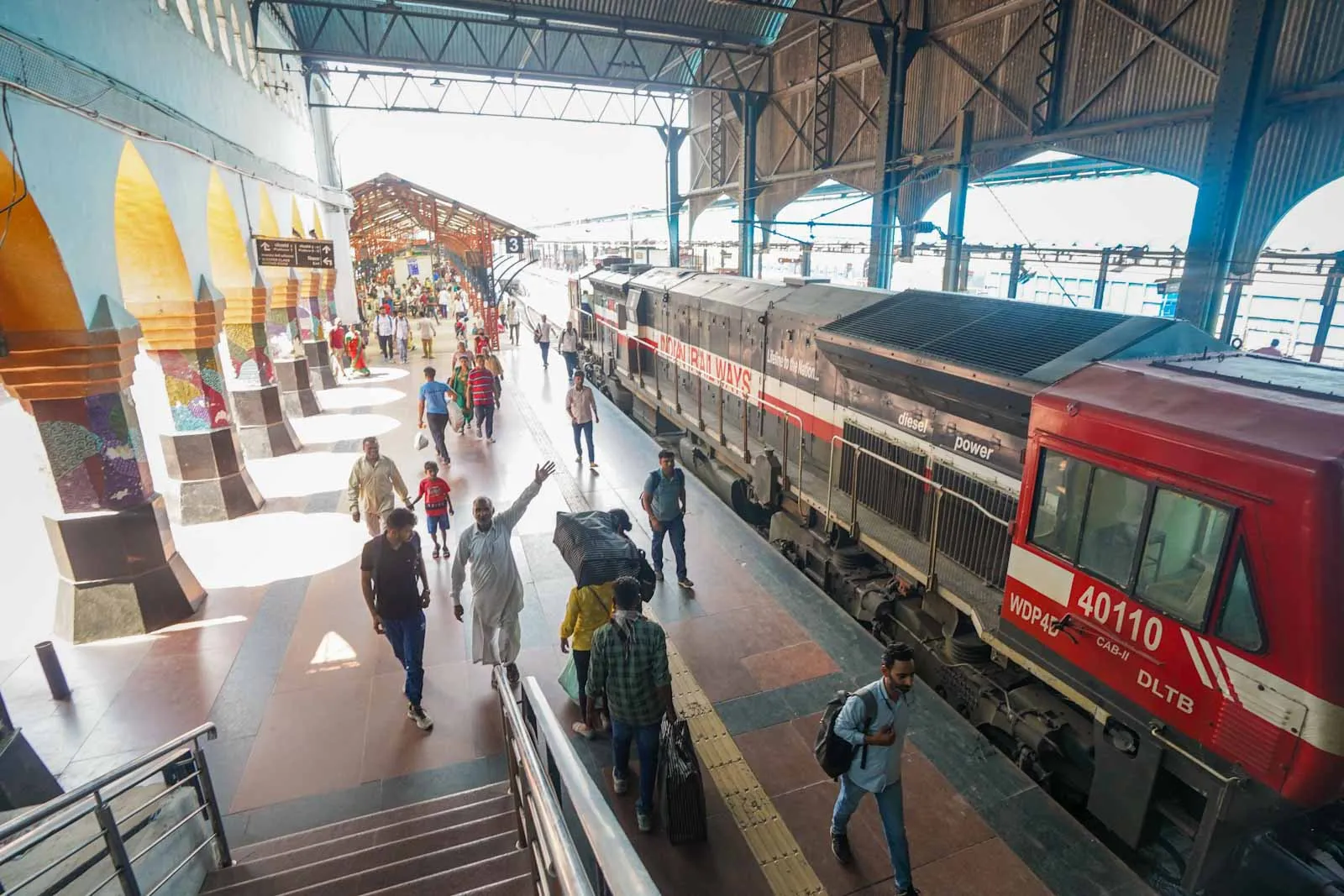
Thinking ahead about train travel in India? I would say that for a traveller, taking a train in India is something of a rite of passage.
Stretching across nearly 70,000 kilometres of track and carrying over 20 million passengers every single day, the Indian rail network is much more than just a mode of transport. Rather, taking an Indian train journey is an entire experience!
However, the system can be daunting. From the ‘Waitlist’ mystery to the dozen different classes of travel – and let’s not get started on the toilets – it’s a lot to wrap your head around.
In this guide, we’re breaking down everything we’ve learned from years of train travel in India with our family.
- Train Travel in India
- Types of Train
- Classes of Train Travel
- Booking Tickets
- Logistics
Sleeper Trains
Food & Water
Toilets - Tips for Train Travel in India
- Travelling With Kids
- More About India
Train Travel in India
We come from New Zealand where travel by train is nowhere near like any of the Northern Hemisphere countries that we visit. But train travel in India is a whole different beast again.
There is no better way to truly see India than from the window of a train. The Indian Railways network is massive, serving as the literal lifeblood of the country, carrying millions of people across vastly different landscapes every single day.
Train Travel in India as a Traveller
The experience is hard to describe as a traveller.
Whether you’re tucked into an air-conditioned berth or sitting by the open door of a Sleeper class carriage, the experience is a total sensory immersion.
You’ll hear the melodic “chai-chai” calls of the station vendors before you even see them, share snacks with friendly families across from you, and watch the transition from the crowded city outskirts to the dusty plains.
It can be chaotic, and the logistics of booking might feel like a puzzle, but a long-haul train journey is where the real magic of Indian travel happens. 🙂
Part 1: Understanding the Classes of Train Travel in India
Indian trains often have up to seven different classes on a single locomotive.
Choosing the right one is the difference between a restful journey and a very long, cramped night!
The Sleeper Classes (For Overnight Journeys)
- AC First Class (1AC): The pinnacle (in theory) of luxury train travel in India. These are lockable 2-berth or 4-berth compartments with bedding included. It’s private, quiet, and the most expensive.
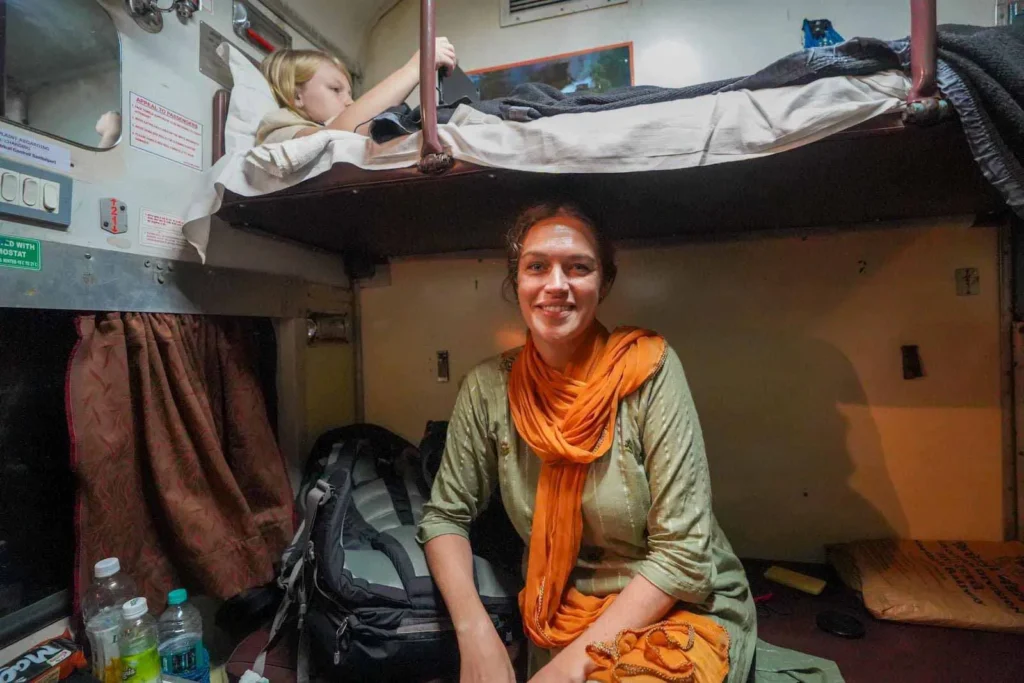
- AC 2-Tier (2AC): These are open-plan carriages with four beds in a compartment and two “side” beds across the aisle. Crucially, there are privacy curtains on every bunk, and bedding is provided.
- AC 3-Tier (3AC): Like 2AC but with six beds in a compartment (three on each side). There are no privacy curtains, and it can feel a bit crowded, but it is air-conditioned and comfortable.
- Sleeper Class (SL): The “classic” Indian rail experience. No air conditioning (only fans and open windows) and no bedding provided. It’s loud, dusty, and vibrant.
AC First Class (1AC) is best for longer and overnight journeys. Plus, it is a good way to ease into train travel in India if it’s your first time! We book 1AC for our Group Trips travelling from Jaisalmer to Jaipur overnight.
When it is just our family travelling or if we are doing a shorter journey, we are comfortable with 2AC.
For shorter daytime journeys (or if there is no other option) Sleeper Class (SL) is an experience!
The Seating Classes (For Daytime Journeys)
- Executive Chair Car (EC): Found on premium trains like the Shatabdi. Think of it as ‘Business Class’ on a plane—wide seats, plenty of legroom, and meals served at your seat.
- AC Chair Car (CC): Very comfortable 3+2 seating with air conditioning. Perfect for the 4-hour hops between Delhi and Agra or Jaipur.
- Second Seating (2S): Non-AC reserved seating. It’s cheap (and rugged) and can get very crowded.
Part 2: Types of Trains in India
Not all trains in India are created equal. Some fly across the country with beautiful air-conditioning cranking, while others crawl through every village with the windows wide open (or non-existent).
- Vande Bharat Express: The newest, fastest, semi-high-speed trains in India. They are sleek, world-class, and only have Chair Car classes.
- Gatimaan Express: Currently the fastest train in India, connecting Delhi to Agra in just 100 minutes.
- Shatabdi & Rajdhani: The ‘Premier’ long-distance trains. Rajdhani connects Delhi to state capitals, while Shatabdi connects major cities. Meals are usually included in the ticket price.
- Mail/Express Trains: These are the standard long-distance workhorses. They are slower but cover every corner of the country.
Part 3: How to Book Tickets for Train Travel in India
Booking tickets for train travel in India used to involve standing in a hot queue at a Foreigner Registration Office. Thankfully, those days are gone.
It is (relatively) easy to book tickets for the Indian trains online now.
There are several options:
1. Booking Online (Recommended)
You can book tickets up to 120 days in advance. For popular routes (like Delhi to Jodhpur), tickets for the higher classes sell out within hours of opening.
We always use 12GoAsia and find it the best for putting our India itinerary into action.
But it is well worth checking ahead and making your plans in advance of the tickets opening.
- 12GoAsia: This is the easiest platform for international travellers. They accept foreign credit cards and handle the interface with the Indian Railways (IRCTC) system for you.
- ConfirmTkt: An excellent app for checking PNR Status and the probability of a waitlisted ticket getting confirmed.
2. The Foreign Tourist Quota (FT)
Indian Railways reserves a small number of seats on popular trains specifically for foreign tourists.
These can only be booked online via the IRCTC website (which requires a verified account) or at major international bureaus in cities like Delhi, Mumbai, or Kolkata.
3. Understanding the Waitlist (WL) & RAC
I am still not even quite sure I understand this part of train travel in India!
However, these are the Waitlist codes which are helpful (necessary) if you aren’t able to book your ticket in time through 12GoAsia:
- Confirmed (CNF): You have a seat/berth.
- RAC (Reservation Against Cancellation): You are allowed on the train, but you share a berth with another person unless someone cancels.
- Waitlist (WL): You cannot board the train. If your number doesn’t move to “Confirmed” by the time the chart is prepared (4 hours before departure), your ticket is automatically refunded.
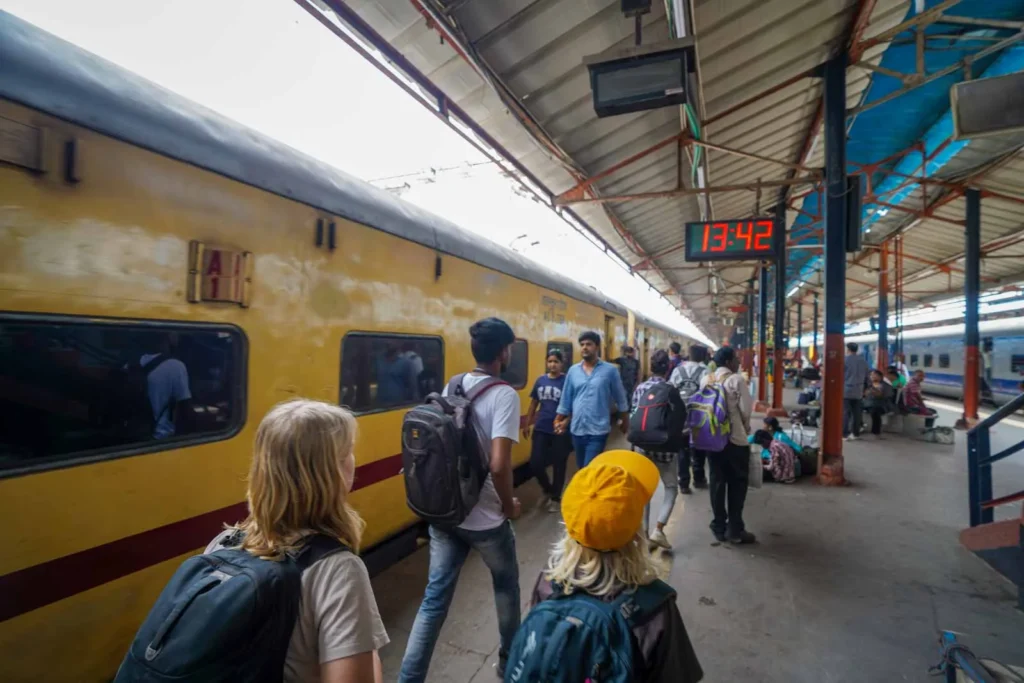
Part 4: Tips for Train Travel in India
These are some of the things I wish I had known before taking those first journeys by train in India. (Although there are a few questions I would have been too shy to ask – about toilets – anyway!).
1. Finding Your Platform and Coach
Indian stations are massive and chaotic.
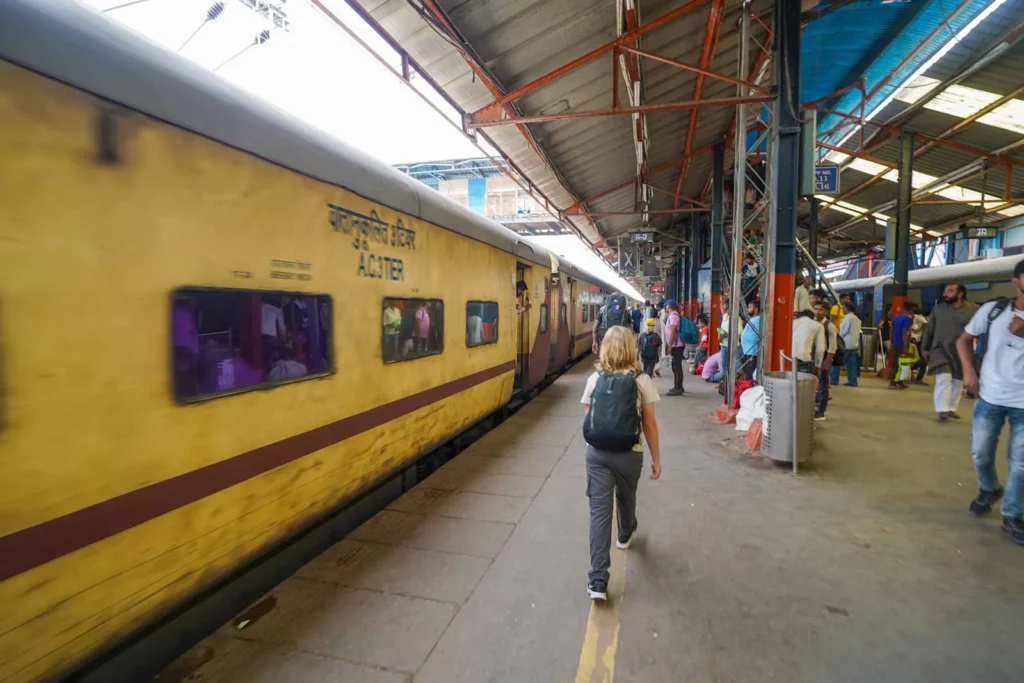
- Download “Where is my Train”: This app is a lifesaver. It tells you exactly which platform your train is on and, more importantly, where your specific coach (e.g., B2 or A1) will stop on the platform.
- The Chart: For 1AC travel look for the printed charts pasted near the coach doors or on the platform; they list every passenger’s name and seat number.
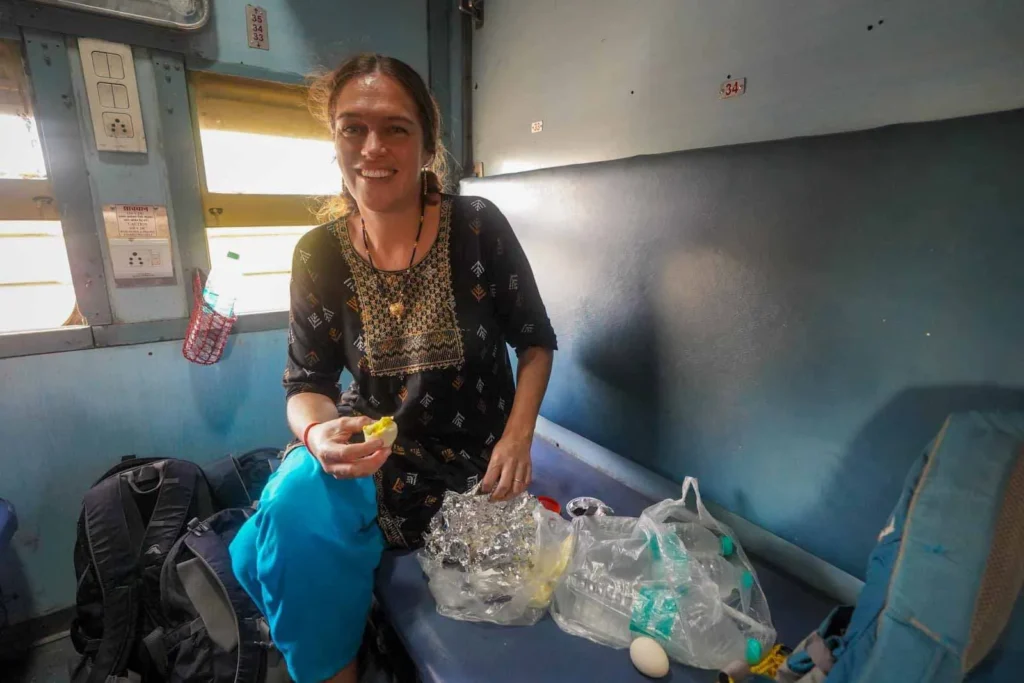
2. Food and Water
On long distance trains in India there will often be the option to purchase a ‘Food-Included’ option when buying your ticket online. But don’t panic it you can’t see this option available.
While there aren’t restaurant or buffet cars on Indian Railways, on long distance trains there are plenty of train attendants who will come to your cabin or car and ask if you would like to order food.
- Attendants: For snacks, drinks, water and chai on the popular routes the attendants come through the cars regularly selling different options for a few rupees. You will hear the call of “Chai, Chai-Chai!”
- E-Catering: You can now use apps like Zoop or IRCTC Catering to order Domino’s, KFC, or local restaurant food to be delivered directly to your seat at a specific station!
- Water: Attendants come through with water and cold drinks. Only drink ‘Rail Neer’ or other sealed brands like Bisleri.
3. Safety and Security
Safety-wise, we have always felt comfortable making journeys of train travel in India. But as with travel anywhere in the world, there are a few tips to make your security feel smoother.
- Luggage: Bring a small bicycle lock or a specialized luggage chain. Most berths have a metal loop underneath the seat where you can chain your bag.
- Valuables: Keep your passport, phone, and wallet in a small day bag that stays with you (attached or under your pillow) at all times.
- Solo Female Travelers: Stick to Upper Berths in 2AC or 3AC. It gives you your own (sort-of) private space away from the aisle traffic.
4. Electronics and Charging Your Devices
In the AC sleeper cars (1A, 2A, and 3A), you will find electric shaver sockets located near the berths. While they are technically for shavers, they work perfectly fine for recharging mobile phones and other small devices.
Though, a quick word of advice: the sockets are generally reliable, but they can be a bit temperamental.
They usually work, but it’s always a good idea to have your devices topped up before you board or carry a power bank as a backup, just in case your particular outlet is having a day off.
5. Bedding and Berths
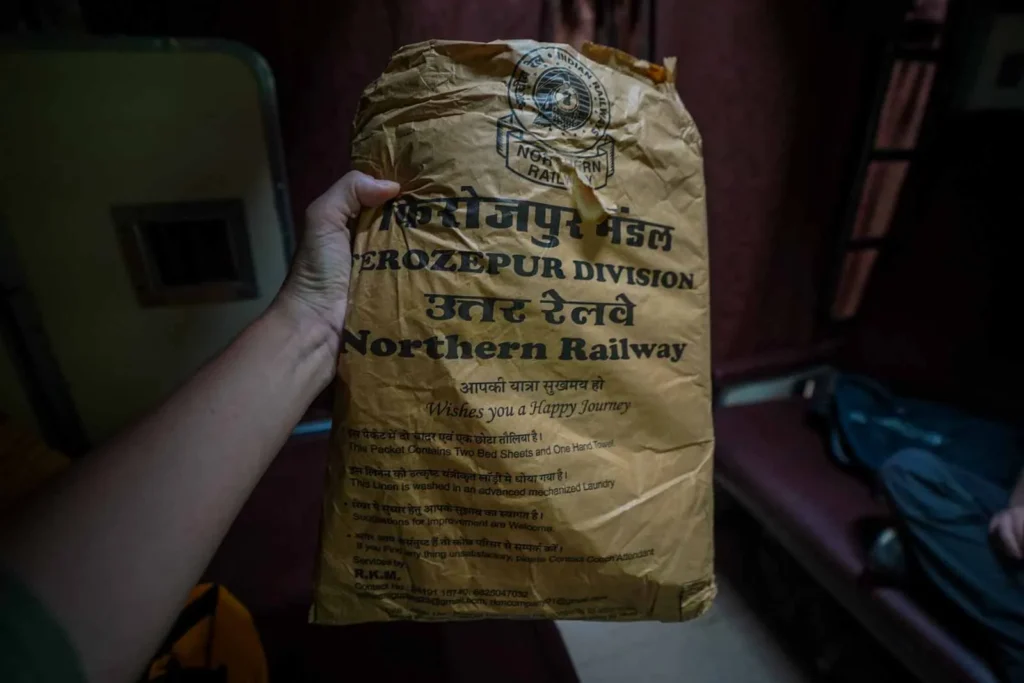
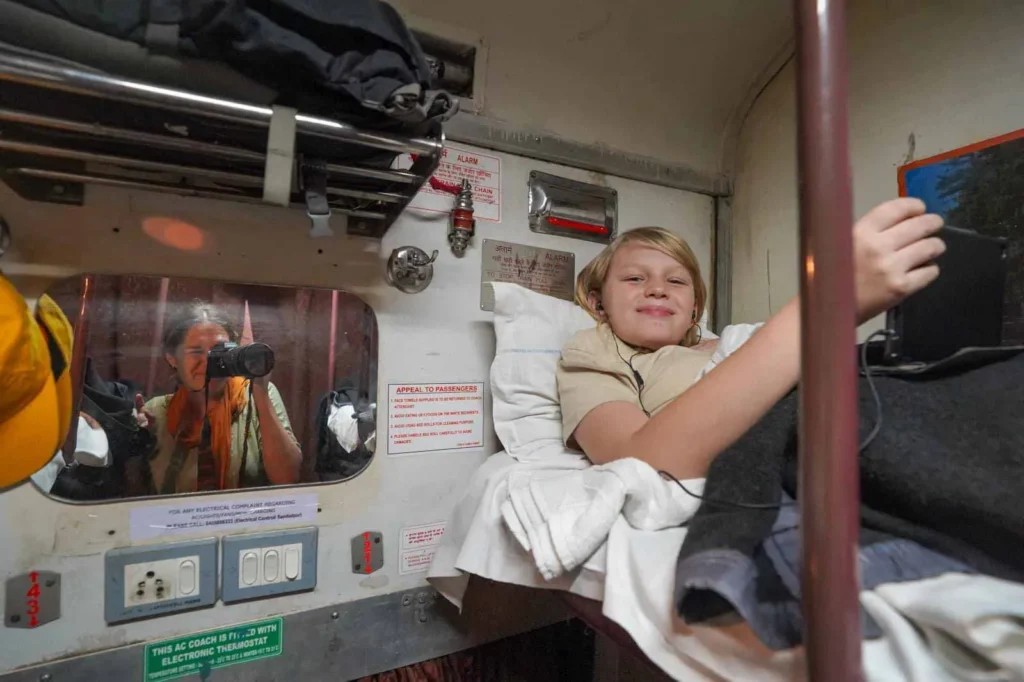
One of the most pleasant surprises about Indian train travel is the quality of the bedding. If you are traveling in 1A or 2A, fresh linens are provided for any medium-to-long distance journey.
- The Linens: You’ll receive a set of sheets and a pillowcase that have been bleached, pressed to perfection, and neatly packaged in a sealed paper bag. It’s a small touch of hygiene that goes a long way in making the berth feel like your own little space.
- The Berths: The beds are basic padded berths. Even for us—and we are a fairly tall bunch from New Zealand—the bed length is standard and plenty long enough to sleep comfortably without having to curl into a ball.
6. The Toilet Situation
Alright. Let’s address the elephant in the room.
We’ll be honest: we were genuinely nervous about this aspect of train travel in India. But after crisscrossing the country dozens of times, we can candidly say the experience turned out to be better (and much less scary) than we anticipated.
Perhaps we are becoming concerningly ‘seasoned’ travellers, and more hardened to such toilets. But the reality is that the facilities are basic, functional, and perfectly manageable if you come prepared.
What to Expect Onboard
The quality of the facilities varies significantly depending on which class you are traveling in.
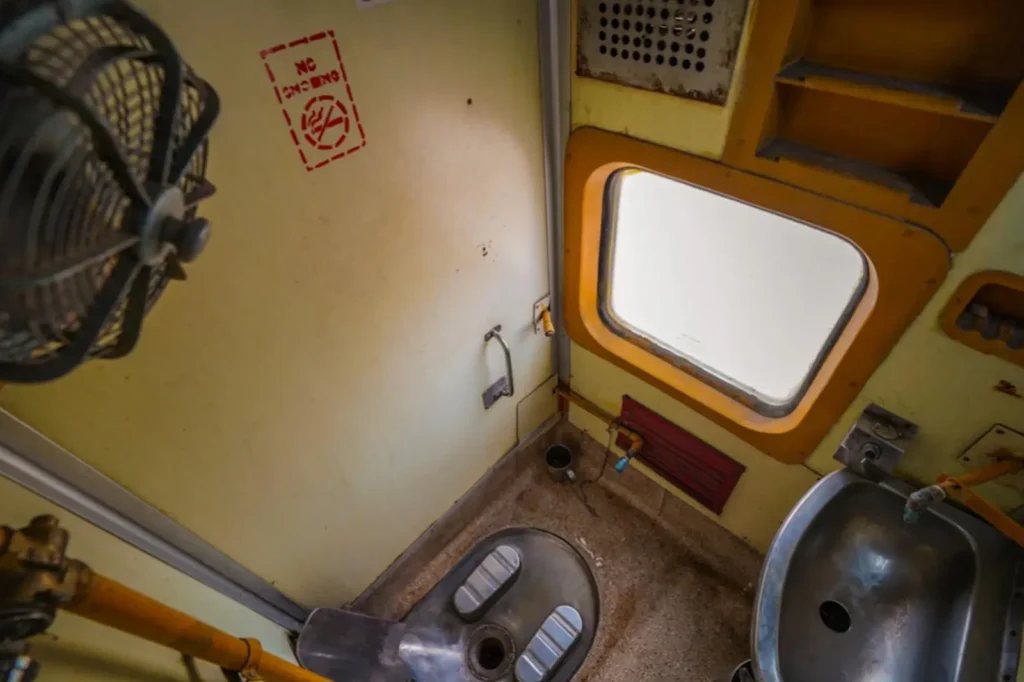
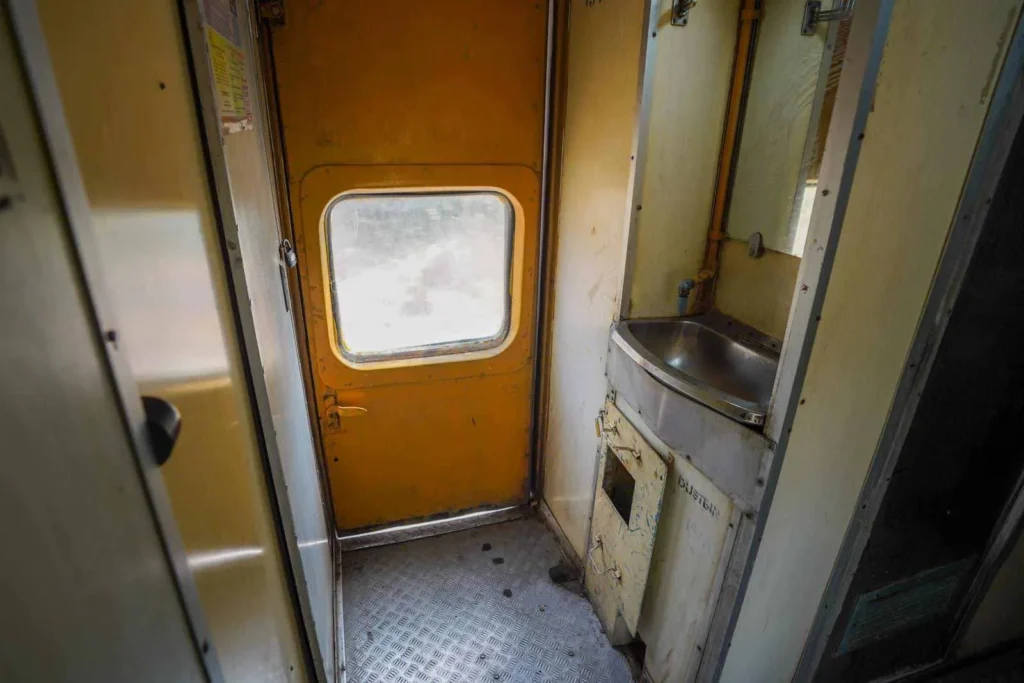
In the AC Classes (1AC, 2AC, and 3AC), you’ll typically find two toilets at each end of the carriage.
Usually, there is one Western-style toilet and one Indian-style squat toilet.
Even in First Class (1AC), there is almost zero chance of finding toilet paper. Indian toilets use a water spray or a “lota” (small jug) for washing.
On a positive, one of the biggest perks of the AC classes is that tickets are pre-purchased and seating is assigned. This means the carriages (and the toilets) don’t suffer from the same overcrowding you might find in General Class.
Good news, eh?
- Tip (Essential): Always carry your own toilet paper and hand sanitiser. The toilets are cleaned at ‘Clean Train Stations’ along the route, but they can get messy toward the end of a 20-hour trip.
Facilities at the Station
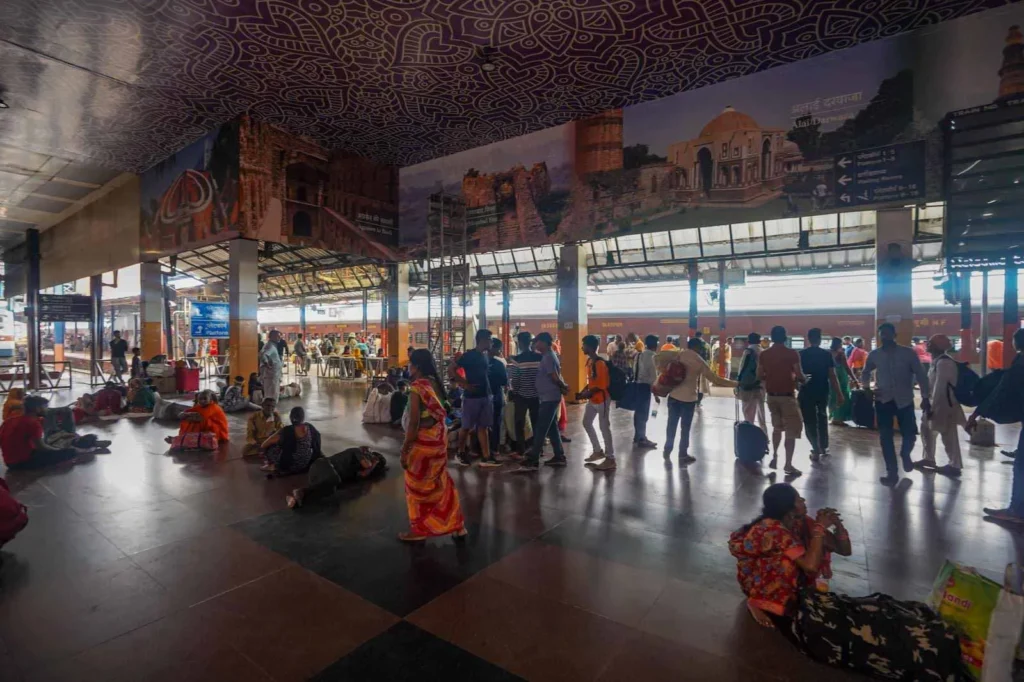
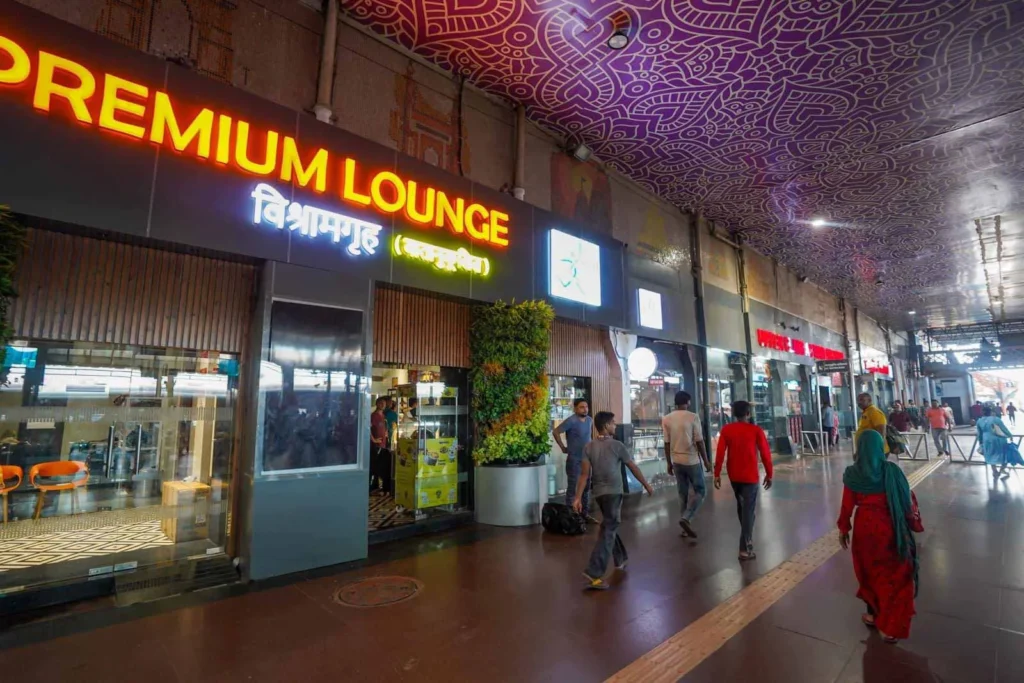
Station facilities are a bit of a mixed bag. Large city stations (like Delhi or Jaipur) have decent waiting rooms with designated toilets, while smaller rural stops might be a bit more ‘rustic’.
- Waiting Rooms: If you have a confirmed AC ticket, you can access the AC Waiting Halls. These are generally cleaner, quieter, and have better-maintained restrooms.
- Station Shops: If you realise you’ve forgotten the essentials, don’t panic. Most major platforms have small kiosks selling everything from water and snacks to wet wipes, soap, and even colouring books to keep the kids entertained during a long haul.
Our Top Toilet Tip?
Don’t let the toilet talk put you off. The facilities depend largely on the size of the city and the class of your ticket, but if you have any doubts, just ask.
Most people are incredibly helpful, and once you’ve done your first overnight journey, you’ll realise it’s just another part of the great Indian adventure!
Part 5: Train Travel in India with Kids
We’ve done dozens of journeys by train in India with our kids, and it’s actually their favourite way to travel.
The train itself is the entertainment. Especially coming from New Zealand where we don’t do train travel! Watching the world go by from an open door (with supervision!) or a window is better than any iPad.
- Free for Little Ones: Children under 5 travel for free (but don’t get a separate seat). Children aged 5–12 pay half fare if they don’t take a separate berth, or full fare if they do.
- Our Advice: Pay for the extra berth. Having the space is worth every cent.
Part 6: Why the Train is Better than Flying
While India has many low-cost airlines, the train remains the superior choice for the conscious traveller.
It really is an awesome experience. You see the “real” India—the villages, the water buffalo, the temples, and the changing geography that you miss from 30,000 feet.
Plus, rail travel has a significantly lower carbon footprint than short-haul flights.
Stations are usually in the heart of the city, whereas airports are often 90 minutes away in traffic. So, an overnight train saves you the cost of a hotel night too!
Final Thoughts
The Indian Railways can be a test of patience. There will be delays, there will be noise, and definitely there will be moments of confusion. But there will also be incredible kindness—a stranger sharing their paratha with you, a child waving from a field, and that friendly, iconic call of the Chai Wala at (every) station.
Don’t be afraid of the system. Book your tickets early, pack your hand sanitiser, and get ready for an epic adventure that is train travel in India! 🙂
Ready to book your first trip? Check out our Golden Triangle Itinerary to see how to link Delhi, Agra, and Jaipur by train.
Do you have a question about a specific train route or class? Drop it in the comments below and we’ll do our best to help you out!
Safe travels, adventurers!
Read More India Inspiration
- Ultimate India Food Tour: 10 Must-Try Treats.
- India Tourist e-Visa: Our Step-By-Step Guide.
- 10 Things To Do In Kochi & Kerala.
- Best Tourist SIM Card For India.
- What To Wear In India.
- 10 Tips To Avoid Delhi Belly In India.
- 4-Day Kochi & Kerala Itinerary.
- Travelling India By Bus: Intercity, Tourist & Sleeper Buses.
- 10 Iconic Things To Do In Kolkata.
Travel Planning for India & Beyond
These are the companies we use while traveling and that we would recommend to anyone planning and booking travel.
- Booking.com – The best all-around accommodation booking site. They have the widest selection of budget accommodation and it’s easy to filter and sort into price and availability with all the extras you are looking for personally.
- 12GoAsia – Book trains anywhere in Asia through 12Go.
- Skyscanner – Our favourite flight search engine. They can search small websites and budget airlines that larger search sites often miss. We book all our flights through Skyscanner.
- GetYourGuide – A huge online marketplace for tours and excursions offered all around the world. Everything from walking tours to street-food tours, cooking classes, desert safari’s and more!
- SafetyWing – A global travel insurance that covers people from all over the world while outside their home country. You can buy short or longterm; and even if you are out of the country.
- World Nomads – Travel insurance tailored for short or longterm travel and nomads (including those who have already left home). Make sure you have travel insurance before planning train travel in India!

Hi! I’m Sarah. I am the self-confessed dreamer, travel-schemer and the main editor behind this blog. I love to write, and it is a dream come true to share so many experiences together and inspire others in our stories.