
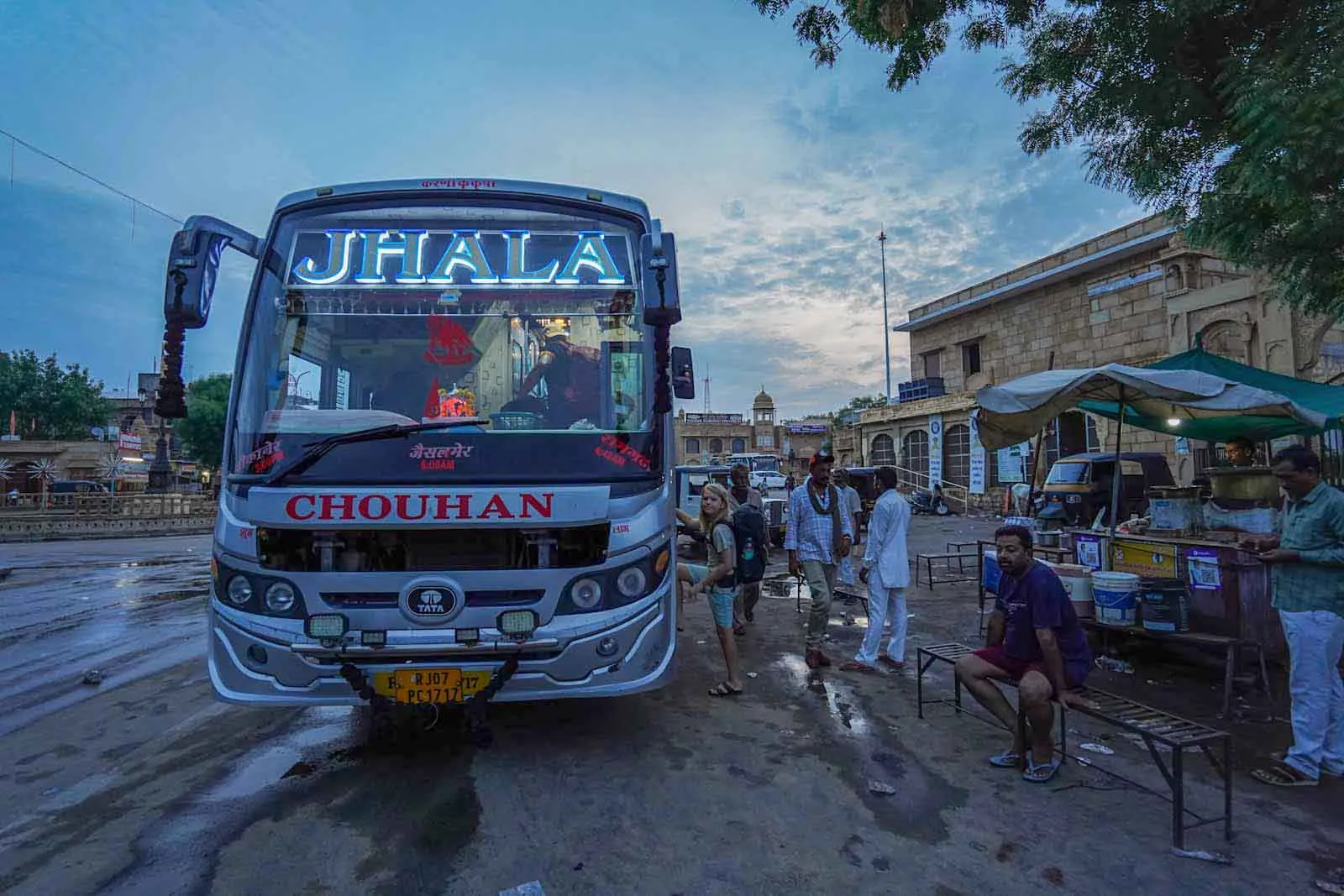
Coming from New Zealand, travel by intercity public transport isn’t something we knew. So making plans for first time travel in South Asia we wanted to know all there was to know about travel by bus in India.
Now, seven trips later and after literally months of travel all over the country we feel confident to share all those questions we wanted to know first.
Travelling India by Bus
To be fair – navigating the roads of India is an experience that defies simple description. It is a choreographed chaos of painted trucks, wandering livestock, humming rickshaws, and—most importantly for the budget-conscious traveller—an endless fleet of buses.
But like the chaos and continual bustle of the country, there is a lot to take in about travel by bus in India.
In a country where the railway system is legendary but often booked out weeks in advance, the humble bus is the unsung hero of Indian transit. From the gridlocked cities to the dusty plains of Rajasthan and the palm-fringed lanes of Kerala, taking the bus is the most authentic way to see the ‘real’ India.
So whether you are looking for the bone-rattling charm of a local journey or the neon-lit luxury of an interstate sleeper, here is the ultimate guide to mastering bus travel in the subcontinent.
PART 1. Understanding the Indian Bus Hierarchy
The first thing to understand is that not all buses are created equal. In India, your choice of vehicle will dictate your comfort, your speed, and your stories.
Depending on your budget and tolerance for ‘character-building’ experiences, you generally have four main choices:
- Local Bus
- Deluxe or ‘Express’ Buses
- Tourist Bus
- Sleeper Bus
The Local Government Bus
These are the backbone of rural and intracity travel. Usually painted in bright primary colours (often red or blue depending on the state), these buses are basic.
They have open windows (no AC), bench seats that may or may not have padding, and a driver who treats every journey like a qualifying lap for a Grand Prix!
- Best for: Short distances (1–3 hours) and ultra-low budgets.
- The Vibe: Loud music, wind in your hair, and a great way to meet locals.

The State Transport ‘Deluxe’ or ‘Express’ Buses
One step up from the local bus, these are operated by state bodies like HRTC (Himachal) or RSRTC (Rajasthan).
They often have ‘2+2’ seating (two seats on each side of the aisle) and are generally more reliable for medium distances.
Some are Volvos, which in India is shorthand for any high-end, air-conditioned coach.

Private Tourist Coaches
If you are traveling between major tourist hubs (like Delhi to Jaipur or Mumbai to Goa), private operators are your best bet. These are almost always air-conditioned and offer much more legroom.
We regularly use these tourist coaches for travel in Rajasthan and more rural India by bus. (Otherwise I still vote to take trains when you can!).
We get these Tourist Buses from Jaisalmer to Jodhpur or Bikaner.
The Sleeper Bus (The Game Changer)
For long-haul journeys, India offers the Sleeper Bus. Instead of seats, these buses feature double-decked berths or cubicles.
- Single Berths: A narrow bed for one person.
- Double Berths: A wider bed intended for two people (perfect for couples, awkward for strangers). These allow you to cover vast distances overnight, saving you the cost of a hotel room.
Read our Step-By-Step Guide To Apply For a Tourist e-Visa For India.
PART 2. Buying Tickets: India by Bus
The days of wandering aimlessly through a dusty bus terminal hoping for a seat are largely over (though the old ways still exist for those seeking adventure!).
Rather, there are several options for buying tickets for travel in India by bus that make it a lot easier.
Online Booking (Recommended)
The most efficient way to book private and many state-run buses is through apps.
- RedBus: The undisputed king of bus booking in India. It allows you to see ratings, photos of the bus, and—crucially—choose your specific seat or berth.
- MakeMyTrip & Goibibo: Great for comparing prices between different operators.
- State Portals: Many state transport websites now allow online booking, which is vital for popular routes like the night bus to Leh or Shimla.

Travel Agents
In every backpacker hub (like Paharganj in Delhi or the lakeside in Udaipur), you will find small travel stalls. They can book private buses for a small commission. This is helpful if you are having trouble with a foreign credit card on an Indian app.
Or – this is what we usually find easiest – you can ask your accommodation host to book for you. They likely get a small commission and will have a booking ticket on hand for the regular routes.
- Tip: For example, in Jaisalmer our host at Wanderlust Guesthouse has a ticket book for the bus Jaisalmer to Jodhpur and drops us right off at the bus stop to travel.

‘On the Fly’ (Local Style)
For local government buses, you don’t book ahead. You simply show up at the ‘Bus Stand’, find the platform for your destination, and hop on. A conductor will eventually walk down the aisle to collect your fare and issue a paper ticket.

PART 3. Practicalities of Travel in India by Bus
Bus travel in India requires a specific set of survival skills. It is much less structured than train travel. Though do remember that hundreds (I mean, literally thousands and thousands) of people travel India by bus every day.
It’s rugged – but they know their stuff!
The ‘Dhaba’ Stop
Indian bus drivers don’t just drive; they eat too. Every 3–4 hours, the bus will pull into a roadside dhaba (eatery).
These stops are usually 20–30 minutes long. This is your chance to use the restroom, grab a hot chai, or eat a plate of fresh dal tadka.
- Tip: Take note of your bus’s license plate number. At a crowded truck stop at 2:00AM, twenty white buses can look identical.

Luggage Logistics
On local buses, your large backpack will likely go on the roof (it will be lashed down with ropes) or in a small space behind the driver.
On AC and Sleeper buses, there is usually a luggage hold underneath.
- Safety: Always keep your valuables (passport, camera, cash) in a small day pack that stays with you at your seat or in your berth.
The Motion Sickness Factor
Indian roads are a mix of smooth new expressways and potholed mountain tracks. If you are prone to motion sickness, the combination of diesel fumes and aggressive cornering can be a challenge.
- Tip: Carry motion sickness tablets, and try to sit toward the front of the bus where the bounce is less pronounced. (A bit less pronounced I mean!).

PART 4. Tips for Travel by Bus in India
The buses in India vary tremendously in condition and comfort.
Whether you are taking a shorter (planned, shorter) Local Bus or a Tourist Bus in India, here are a few tips for a smoother journey.
1. Choose Your Seat Wisely
On a Sleeper Bus in India, try to get a ‘Single Lower’ berth in the middle of the bus. Especially if you are travelling solo. (This is essential!).
The ‘Upper Berths’ can feel like you’re in a pinball machine during sharp turns, and the very back of the bus experiences the most bounce over speed bumps.

2. Dress in Layers
This is the great Indian paradox: it can be 40°C (104°F) outside, but the air conditioning on a ‘Volvo’ bus in India will be set to Arctic Tundra!
Always have a cardigan, hoodie or a light blanket in your carry-on, even in the middle of summer.
3. The Pink Seat Rule
In many state-run buses, the front rows are reserved for women. If you are a solo female traveller, these are the safest and most comfortable places to sit. If you are a male traveller, be prepared to move if a woman boards and needs that seat.
4. Arrival Times are Suggestions
Traffic jams in India are legendary. A ‘10-hour’ journey can easily become a 14-hour saga due to road construction, festivals, or a particularly stubborn cow in the middle of the highway.
Never book a tight connection (like a flight) immediately following a long bus ride.
5. Track Your Progress
Download Google Maps and save the offline version of your route. Indian bus stations aren’t always clearly marked, and conductors may shout the destination in a local dialect you don’t recognise.
Tracking your blue dot on the map tells you exactly when to start gathering your bags and helps to feel a wee bit more in control of where in India you are!
6. Hydration vs. Bladder Control
While it’s important to stay hydrated, remember that bathrooms on Indian buses are virtually non-existent. You are at the mercy of the driver’s scheduled stops. Sip water slowly rather than chugging it!
7. Noise Management
Between the Bollywood movies playing on the overhead TV and the driver’s penchant for using the horn as a musical instrument, Indian buses are loud.
A good pair of noise-cancelling headphones is worth its weight in gold. 😀
PART 5. Why Take the Bus in India?
With all the talk of ‘Red Rockets’ and Arctic air conditioning, you might wonder why you wouldn’t just take a train or a short flight.
That is a fair call!
But the answer lies in the experience. The bus takes you through the heart of Indian villages. You’ll see farmers tending to mustard fields, colourful wedding processions blocking the road, and the incredible geography of the country unfolding at eye level. It is a front-row seat to the daily rhythm of over a billion people.
Plus, obviously there are some routes where there isn’t a regular train service and so taking one of these famous journeys by bus in India is the only option!
Taking the bus in India is an entire experience. It requires patience, a sense of humour, and perhaps a bit of breakbone resilience, but it is an essential part of the Indian experience.

PART 6. Travel by Bus in India
Our advice is to give buses a chance.
We come from New Zealand and long-distance bus travel isn’t really a thing. But taking a bus in India is all part of the adventure of travel in this vibrant subcontinent.
Just give it a chance.
Accommodation: Where to Stay in India
Pigeons aside (Ajmer) there are some great places to stay in India.
These are the hotels and accommodation we use regularly on our travels in Delhi and Rajasthan and that we can recommend for your trip.
Where To Stay in Rajasthan
- Jaisalmer – Budget: The Wanderlust Guesthouse
AMAZING guest-house! We love staying here and can highly recommend. Great rooms; rooftop restaurant overlooking the fort; awesome camel safaris! - Bikaner – Budget: The Prince Haveli
Owner Atik and his staff are very gracious hosts. The Haveli has been lovingly restored and is located right in the centre of the old city. It is a basic accommodation, but the rooms are comfortable, and it is an affordable way to experience a traditional Haveli in Bikaner. - Jodhpur – Budget: Raj Mandir Boutique Homestay
Good location in Blue City, spacious room with small balcony inside Haveli style home. Tiny little doors, lots of unique decor and artefacts.
Where We Stay in Delhi
- New Delhi Airport – Mid-Range: Taurus Sarovar Portico
Beautiful hotel only a few km’s from Delhi International Airport. A great first stop arriving in India with buffet breakfast included and a restaurant onsite. - Delhi – Budget: Hotel Hari Piorko
Good location in the heart of the Main Bazaar, Delhi. Close to restaurants and train station. No view from rooms. - Delhi – Budget: Smyle Inn
Extremely basic hotel in small back alley. Very friendly, helpful staff and simple breakfast included. Just off Main Bazaar.
Travel Planning for India & Beyond
These are the companies we use while traveling fulltime as a family and that we would recommend to anyone planning and booking travel.
- Booking.com – The best all-around accommodation booking site that constantly provides the cheapest and lowest rates. They have the widest selection of budget accommodation and it’s easy to filter and sort into price and availability with all the extras you are looking for personally.
- Skyscanner– This is by far our favourite flight search engine. They are able to search small websites and budget airlines that larger search sites often miss. We book all our flights through Skyscanner.
- GetYourGuide– Get Your Guide is a huge online marketplace for tours and excursions offered all around the world. Everything from walking tours, to street-food tours, cooking classes, desert safari’s and more!
- SafetyWing – A global travel insurance that covers people from all over the world while outside their home country. You can buy it short or longterm; and even if you are out of the country.
- World Nomads – Tailored travel insurance (including for those who have already left home) – MAKE SURE YOU HAVE GOOD TRAVEL INSURANCE BEFORE TRAVELING TO INDIA!

Hi! I’m Sarah. I am the self-confessed dreamer, travel-schemer and the main editor behind this blog. I love to write, and it is a dream come true to share so many experiences together and inspire others in our stories.