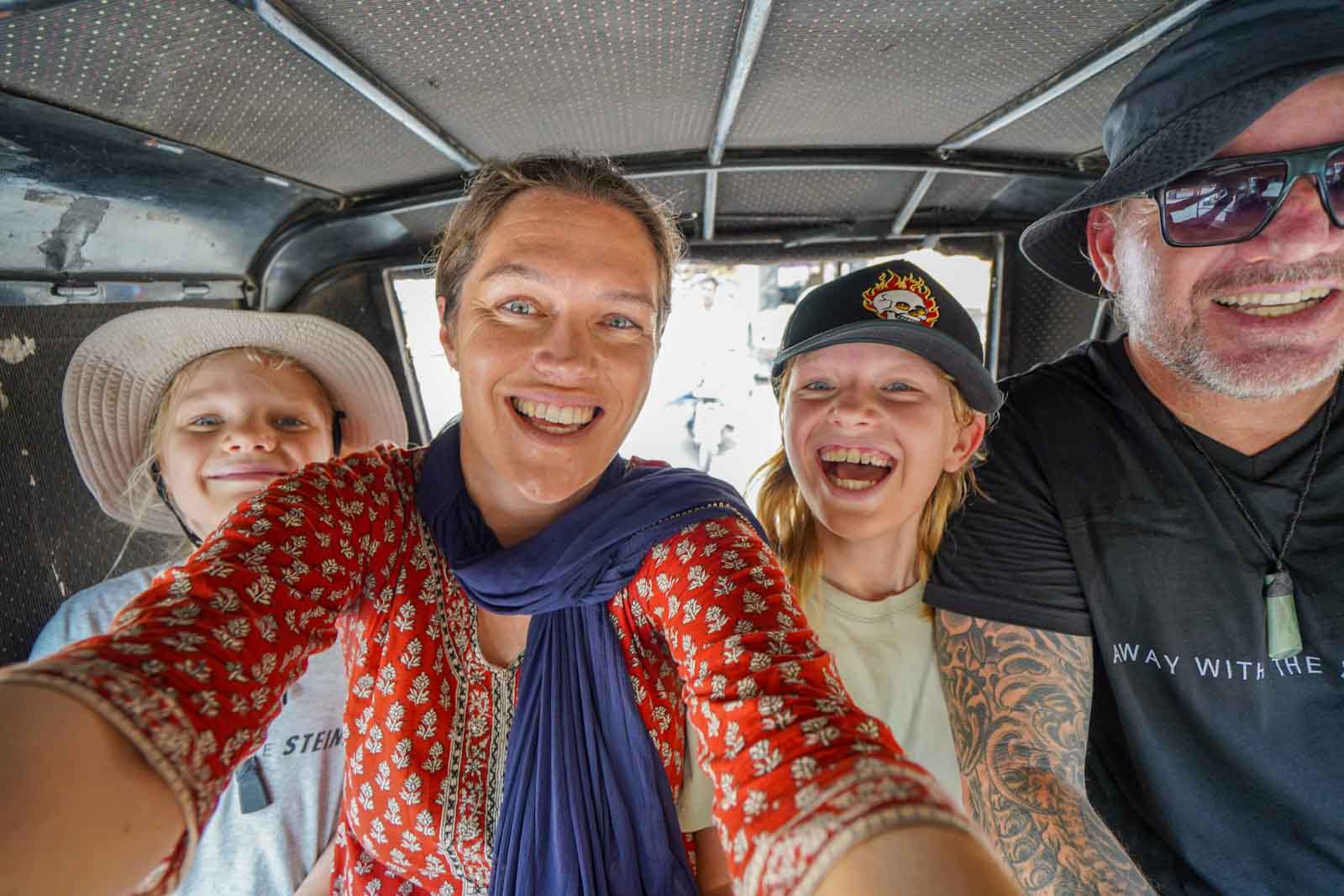
Getting Dengue Fever in India is the kind of travel story you hope to never have. For us, what should have been the final days of an epic South Asian adventure turned into a medical emergency and extended Indian overstay in a New Delhi hospital.
Dengue is endemic in India, with an estimated 40 million cases annually. While it really is a seasonal reality for locals—peaking during and after the monsoon (July to November)—for a traveller, it can be really scary and is absolutely one on the travel list to stay away from.
This guide covers everything you need to know about Dengue Fever in India, how to avoid it, how to recognise it, and what happens if the Breakbone Fever catches up with you.
Ready?
- What is Dengue Fever?
- Getting Dengue Fever in India
- What Happened?
- About Dengue Fever
Symptoms
Prevention - Medical Care in India
- Recovery from Dengue
- More About India
Part 1: What is Dengue Fever?
Dengue – commonly known as Dengue Fever – is a viral infection transmitted to humans through the bite of infected mosquitoes, primarily the Aedes aegypti species.
It is a significant global health challenge, particularly in tropical and subtropical climates.
Dengue Fever in India
Dengue is not your average flu. It is a viral infection transmitted to humans through the bite of infected mosquitoes, and in India, it is considered endemic.
This means the virus is consistently present, with an estimated 40 million people falling ill from various mosquito-borne diseases across the country annually.
The Seasonal Surge
While you can catch Dengue year-round in India, the risk skyrockets during and immediately following the monsoon season (July to November).
Heavy rains leave behind stagnant water in discarded tires, flowerpots, and urban puddles—the perfect nurseries for mosquito larvae.

The Daytime Biters
Unlike Malaria-carrying mosquitoes that are most active at night, the Dengue-carrying Aedes mosquito is a daytime biter. They are most aggressive in the early morning (shortly after sunrise) and late afternoon (before sunset).
- Tip: This is crucial for travellers to understand: you cannot just ‘apply repellent at dinner’ and expect to be safe.
Part 2: Getting Dengue Fever in India
India is a land of vibrant colours, breathtaking landscapes, and an energy that is entirely its own. But for us, it was a tiny mosquito that tuned another dream trip in India into a medical emergency: the Aedes aegypti mosquito.
The story of ‘Getting Dengue Fever in India’ is one that we lived firsthand.
What Happened?
After years of unscathed travel, Gavin was admitted to a hospital in New Delhi on the very day they were meant to fly home. We had just spent the last three years on the go, non-stop, travelling all around Asia, Europe and North Africa with the previous few months in Pakistan and India.
In our final days – we thought we were low on energy and down with the prospect of heading home(!) – Gavin got really sick.
He was eventually diagnosed with Dengue Fever in India.
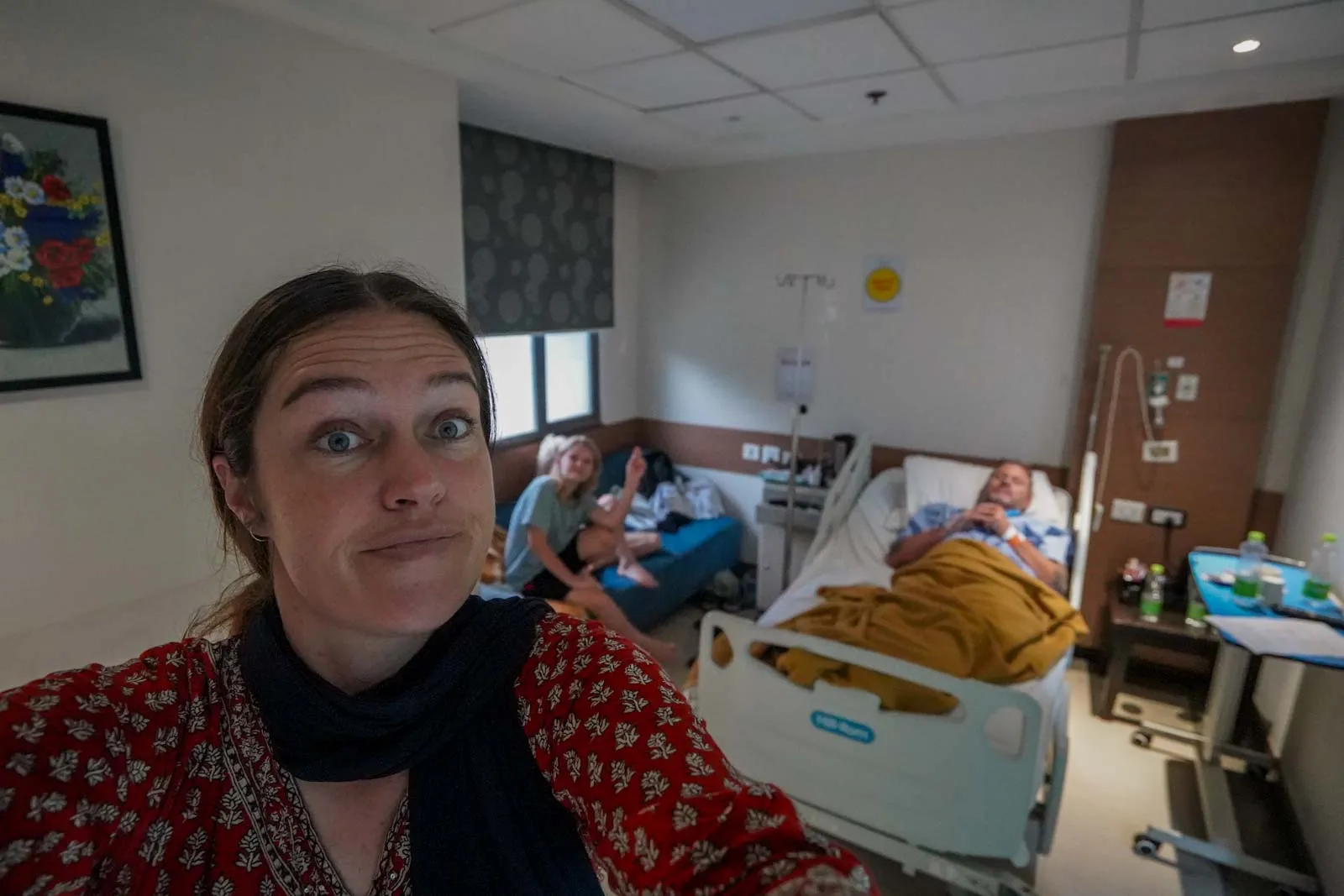
Then what followed was a gruelling week that highlighted just how serious this tropical disease can be. Gavin ended up in hospital in New Delhi with Dengue Fever in India.

Dengue Symptoms for Gavin
Dengue is often called ‘Breakbone Fever’ because of the intense muscle and joint pain it causes.
For Gavin, the symptoms followed a clear, punishing timeline:
- Days 1–4: Sudden high fever, severe frontal headache.
- Day 5: Profound fatigue, loss of appetite, feeling faint or dizzy, and a distinct, agonizing pain behind the eyes.
- Day 7: A bright red, measles-like rash, swollen glands, and continued joint pain.
Mild or Severe Dengue
Mild Dengue Fever can be treated at home. Severe Dengue Fever is not as straightforward.
By the seventh day of continued fever, Gavin was admitted to hospital in New Delhi.
Getting Dengue Fever anywhere in the world is no joke.
IF YOU EXPERIENCE ANY SYMPTOMS OF DENGUE OR SUSPECT YOU HAVE CONTRACTED DENGUE FEVER – SEEK IMMEDIATE MEDICAL ADVICE. Dengue in India can be extremely dangerous.
Part 2: What Happened?
The onset of Dengue is rarely a thunderclap; it is a slow, insidious creep.
Here is Gavin’s story of getting Dengue in India.
Day 1 – 3: The Start of Dengue
It began with a lethargy that felt, at first, like the natural byproduct of a long trip.
India wears you down in the best way possible—the noise, the heat, the constant movement.
But this was different. This was a fatigue that reached into the marrow.
By Day 3, the ‘Breakbone Fever’ had arrived.
The nickname is not hyperactive marketing; it is a literal description of the sensation. Gavin’s joints felt as though they were being systematically disassembled. A relentless headache took up residence behind his eyes, making every flicker of light feel like a needle.
The fever spiked, and he spent the day pinned to a bed, his appetite vanished, replaced by a profound, hollow weakness.
But we still didn’t know what was wrong.
Day 4 – 6: The Descent
There is a psychological toll to being sick in a foreign land. You oscillate between the hope that ‘it’s just a 24-hour bug’ and the terrifying certainty that it is something much worse.
By Day 5, the symptoms had evolved into a dizzying cycle. The fever would break, offering a few hours of false hope, only to roar back with renewed vigour.
When Gavin stood up he had an intense dizziness. Even just standing to get a drink of water. His limbs ached with a dull, throbbing persistence.
Yet still, at this stage we were hoping to make their scheduled flight home. The plan was to power through, to get to the airport, and to deal with the aftermath on home soil.
We still didn’t know what was wrong.
Looking back, I guess it is a common traveller’s instinct: If I can just get home, I’ll be safe.
But Dengue is a disease of timing, and Gavin’s clock was ticking even if we didn’t yet know.

Day 7: The Breaking Point
Day 7 was the day the plan collapsed.
The symptoms had reached a crescendo. Gavin woke to a distinctive red rash across his skin; a hallmark of the virus.
As soon as we saw this bright red we knew instantly.
Confirming Dengue Fever
In some ways it was a relief to know what was wrong. We hadn’t known what was up with only the symptoms of a fever, but no vomiting or other specifics. This was like a lightbulb moment for all of us.
Of course it was Dengue Fever!
Then the realisation hit: we weren’t going anywhere. You cannot fly with a body that is actively losing its battle with a viral load.
It was time to make the call.
We needed to get Gavin to hospital and cancel our flights.

Finally, Getting to Hospital
We called our friends Sunny and Vinny who came immediately in their taxi and took us straight to Fortis Hospital in New Delhi.
The journey to hospital was something of a blur of pain and anxiety. But the next four hours of intake, blood tests, and waiting followed—plus the additional stress of Harry (10) passing out in the Emergency Room and being also admitted to a cubicle for assessment.
Finally, Gavin was admitted as an inpatient.
Harry was fine (just overwhelmed by the whole saga) and we checked Gavin in and by night time, left him to rest and stay.
Day 8 and Beyond: Hospital in New Delhi
The hospital environment in Delhi provided a sharp contrast to the chaos of the streets outside. Inside the ward, the care was clinical, professional, and efficient.
The staff moved with the confidence of people who knew exactly what they were looking at.
Day 8 was the peak of the ordeal.
The Dengue Rash was now prominent, and the exhaustion was absolute.
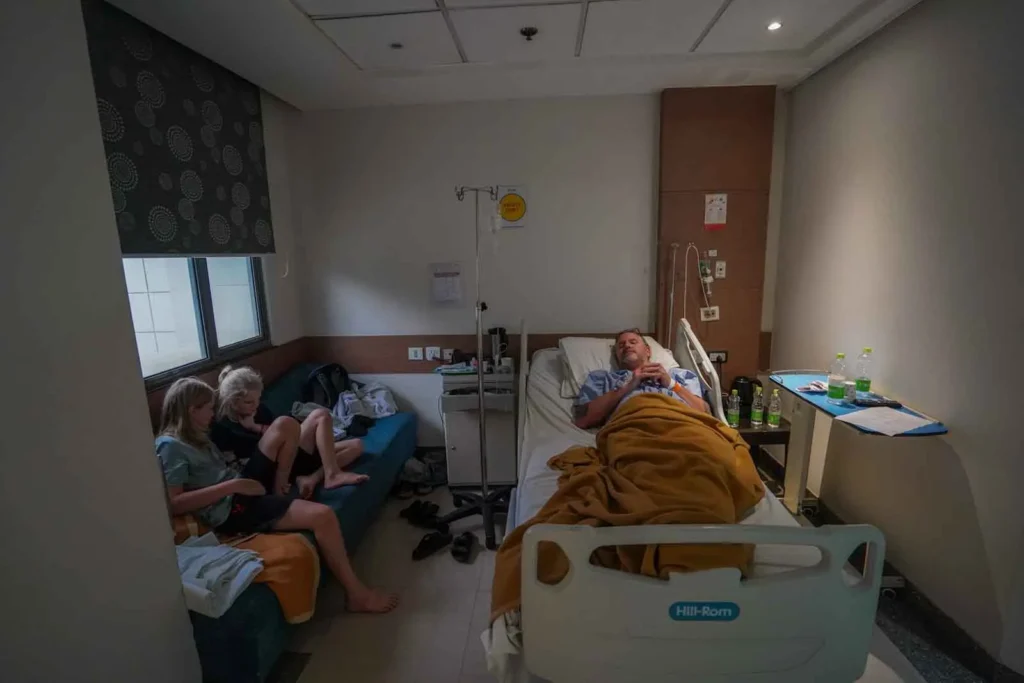
In a Dengue ward, the primary ‘treatment’ is a paradoxical combination of intense monitoring and frustratingly little intervention.
Because Dengue is a virus, there is no ‘cure’—no magic pill to kill the infection. The medical team’s job is to manage the symptoms and prevent the condition from spiralling into the life-threatening Dengue Haemorrhagic Fever.
The routine is defined by the Platelet Watch.
Dengue causes a sharp drop in blood platelets (thrombocytopenia), which are essential for clotting. If they drop too low, internal bleeding becomes a catastrophic risk.
So Gavin’s days were marked by constant hydration—IV drips and oral fluids—and a whole lot of that as a reminder with the continued beep of monitors.
Part 4: Symptoms of Dengue Fever in India
Understanding the symptoms of Dengue Fever in India is critical, especially since the transition from “standard” to “severe” can happen quite rapidly as the initial fever begins to fade.
Here is a breakdown of the progression and warning signs based on World Health Organization (WHO) guidelines.
1. The Initial Phase: Common Symptoms
Symptoms usually manifest 4–10 days after being bitten by an infected mosquito and typically last for 2–7 days.
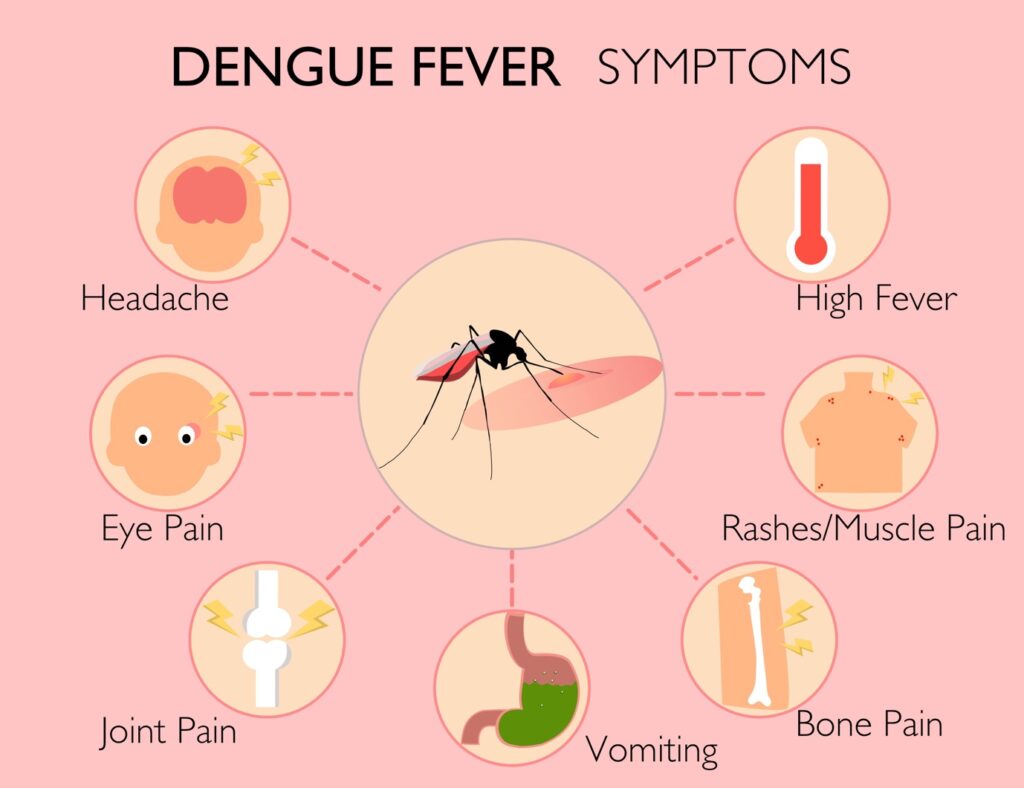
A Dengue infection generally begins with a sudden, high fever accompanied by at least two of the following:
- Retro-orbital pain: Severe headache specifically concentrated behind the eyes.
- ‘Breakbone’ pains: Intense aching in the muscles and joints.
- Gastrointestinal distress: Nausea or persistent vomiting.
- Lymphadenopathy: Swollen glands.
- Dengue Rash: A skin rash that often appears a few days after the fever’s onset.
2. The Critical Window: Severe Dengue
Severe Dengue is a life-threatening medical emergency.
Crucially, warning signs typically emerge 24–48 hours after the initial fever has subsided.
- Note on Re-infection: If you have had Dengue before, you are at a significantly higher risk of developing the severe form during a second infection with a different strain.
Watch for these “Red Flags” as the temperature drops:
- Severe abdominal pain or continuous vomiting.
- Respiratory distress: Rapid or laboured breathing.
- Mucosal bleeding: Bleeding from the nose or gums.
- Haemorrhagic signs: Blood appearing in vomit or stool.
- Systemic shock signs: Pale, cold, or clammy skin; extreme thirst; or profound restlessness and irritability.
3. The Recovery Phase (and the Dengue Hangover)
The end of the acute infection does not always mean an immediate return to 100% health.
Recovery from Dengue in India is not like recovering from a cold.
Expect to feel weak for 2–4 weeks after the fever vanishes.
The post-dengue phase is often characterized by profound fatigue and physical weakness that can linger for several weeks.
Patience and continued hydration are essential during this period of convalescence.
IF YOU EXPERIENCE ANY SYMPTOMS OF DENGUE OR SUSPECT YOU HAVE CONTRACTED DENGUE FEVER – SEEK IMMEDIATE MEDICAL ADVICE. Dengue in India can be extremely dangerous.
Part 5: Seeking Medical Care for Dengue in India
If you suspect you have Dengue, seek medical advice immediately.
Do not wait until you return home.
Indian Hospitals Know Their Stuff
As Gavin found in New Delhi, Indian doctors are experts at treating tropical fevers.
Because Dengue Fever in India is so common, the medical infrastructure—especially in major cities like Delhi, Mumbai, and Bangalore—is highly efficient at diagnosing and managing the virus.
What to expect at the hospital:
- The NS1/IgM Test: A quick blood test to confirm the presence of the virus.
- Platelet Monitoring: The hospital will check your CBC (Complete Blood Count) daily. Dengue causes your platelet count to drop; if it falls too low, you risk spontaneous bleeding and will require hospitalization for IV fluids or a transfusion.
The Danger of Aspirin or Ibuprofen
CRITICAL ADVICE: If you have a fever in India, never take Aspirin or Ibuprofen (NSAIDs). These are blood thinners.
Because Dengue already lowers your platelet count, taking these medications can trigger life-threatening internal bleeding.
Only take Paracetamol (Acetaminophen) for pain and fever.
Part 6: Prevention of Dengue in India
Gavin’s experience serves as a powerful reminder that prevention is the only real ‘cure’ for Dengue.
If you are traveling to India—especially during the monsoon or post-monsoon months—you must be proactive.
- Dress for the Occasion: Long sleeves and long pants are not just for modesty; they are your armour. Mosquitoes in India are notorious for biting ankles under tables, so cover up even when you’re just sitting for a meal.
- Repellent is Mandatory: Use high-quality DEET based repellents. Apply it to all exposed skin, and don’t forget your feet and ankles.
- Accommodation Matters: Mosquitoes prefer warm, humid air. Staying in air-conditioned rooms significantly reduces the risk, as the cool air makes the insects less active. Ensure windows have screens and, if necessary, use a mosquito net.
- Eliminate Stagnant Water: While you can’t control the city, you can control your immediate environment. Even a small cup of water left on a balcony can become a breeding ground. It isn’t worth it.
Final Thoughts on Dengue in India?
Getting Dengue in India is a frightening experience, but it shouldn’t stop you from visiting this incredible country.
Despite Gavin’s harrowing experience of being hospitalised in New Delhi, our love for India remains unshaken.
So our story is not a warning to stay away, but a reminder to stay safe.
Getting Dengue in India is a risk. It is a reality that every traveller takes when they enter an endemic zone. But by sharing Gavin’s story, we hope to provide somewhat of a roadmap for others: recognise the symptoms early, don’t try to tough it out on a flight home, and trust the expertise of the local medical professionals. They know their stuff!
If you find yourself in India and the fever begins to climb, seek help, stay hydrated, and know that even in the heart of the chaos, there is a path back to health. 🙂
These are the hotels and accommodation we use regularly on our travels in India and that we can recommend for your trip.
Accommodation: Where to Stay in India
Pigeons aside (Ajmer) there are some great places to stay in India.
Where We Stay in Delhi
- New Delhi Airport – Mid-Range: Taurus Sarovar Portico
Beautiful hotel only a few km’s from Delhi International Airport. A great first stop arriving in India with buffet breakfast included and a restaurant onsite. - Delhi – Budget: Hotel Hari Piorko
Good location in the heart of the Main Bazaar, Delhi. Close to restaurants and train station. No view from rooms. - Delhi – Budget: Smyle Inn
Extremely basic hotel in small back alley. Very friendly, helpful staff and simple breakfast included. Just off Main Bazaar.
Travel Planning for India & Beyond
These are the companies we use while traveling fulltime as a family and that we would recommend to anyone planning and booking travel.
- Booking.com – The best all-around accommodation booking site that constantly provides the cheapest and lowest rates. They have the widest selection of budget accommodation and it’s easy to filter and sort into price and availability with all the extras you are looking for personally.
- Skyscanner– This is by far our favourite flight search engine. They are able to search small websites and budget airlines that larger search sites often miss. We book all our flights through Skyscanner.
- GetYourGuide– Get Your Guide is a huge online marketplace for tours and excursions offered all around the world. Everything from walking tours, to street-food tours, cooking classes, desert safari’s and more!
- SafetyWing – A global travel insurance that covers people from all over the world while outside their home country. You can buy it short or longterm; and even if you are out of the country.
- World Nomads – Tailored travel insurance (including for those who have already left home) – MAKE SURE YOU HAVE GOOD TRAVEL INSURANCE BEFORE TRAVELING TO INDIA!

Hi! I’m Sarah. I am the self-confessed dreamer, travel-schemer and the main editor behind this blog. I love to write, and it is a dream come true to share so many experiences together and inspire others in our stories.